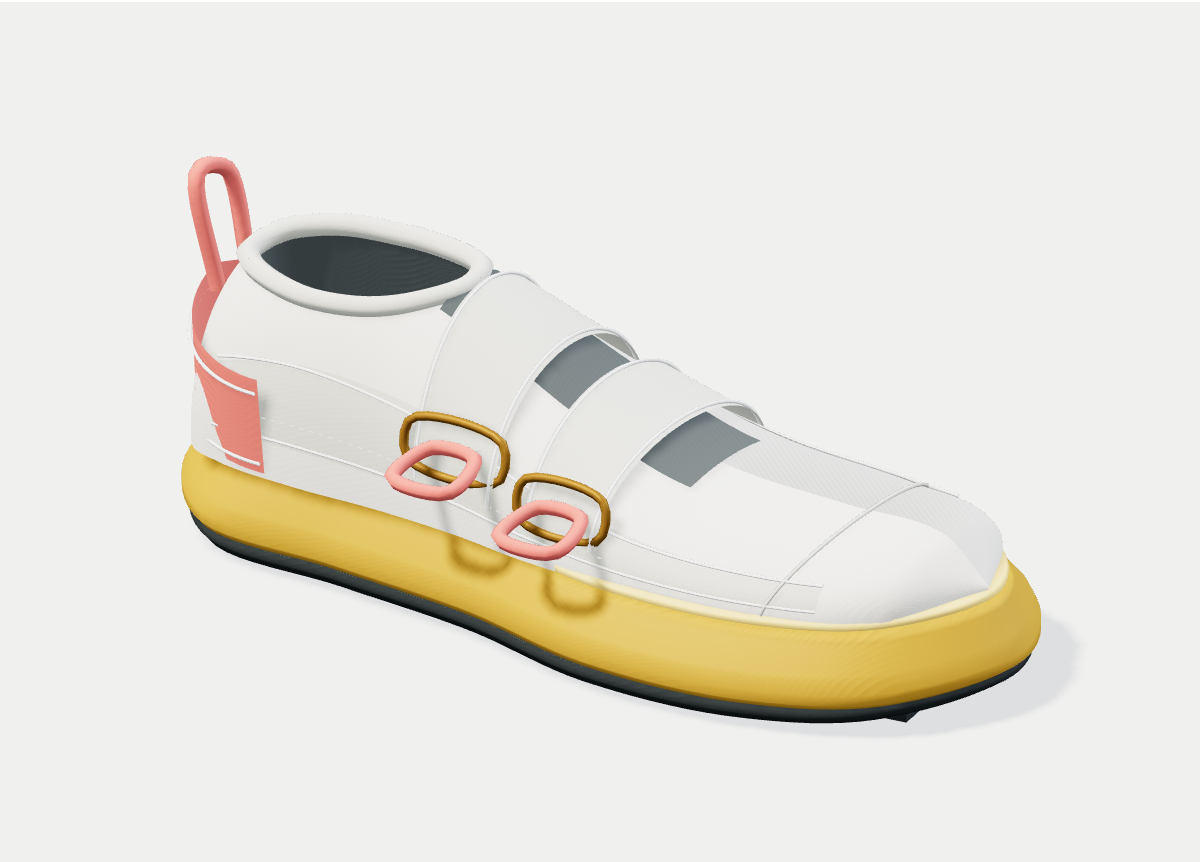
A Footwear Concept for Chorea-Related Instability
Experiment #11 (design study) | July 15, 2026
Read this first: a concept, not a device
This is a computational design hypothesis — an evidence-grounded concept and parametric drawings for experts to critique. It is not a medical device, not validated, and not to be worn. Footwear for a fall-prone neurological population is safety-sensitive: a wrong sole or heel geometry can increase fall risk. Nothing here should change anyone's footwear. We are data scientists, not clinicians.
Could footwear be shaped for the chorea-specific balance problem, rather than the general elderly-balance problem that existing stability shoes already solve?
Why this matters
Falls dominate quality of life in Huntington's disease, and being fall-prone is one of the strongest predictors of nursing-home placement [PMID 30482318]. Around 60% of people with HD are recurrent fallers [PMID 19091714].
The balance problem is specific: chorea (brief, unpredictable involuntary movements) plus increased gait variability and excessive trunk sway, and impaired reactive balance — recovering from an unexpected perturbation, not just planned movement [PMID 30482318]. Tellingly, fall history did not track with disease severity [PMID 24677581], which suggests modifiable factors, possibly including equipment, matter.
Quantitative gait analysis adds a key clue: people with HD spontaneously widen their stance (increased base of support), with shorter, more variable steps [PMID 28851209]. The body is already compensating by widening the base, so a shoe that safely extends the effective base works with that strategy, not against it. It also warns of a limit: the wider the base, the more it can catch during a variable swing.
What already exists, and the gap
Proven, but general
Established stability footwear works and is evidence-backed: New Balance 928v3 (rear-foot control, wide base), Brooks Addiction Walker 2 (rollbar, slip-resistant), Orthofeet, and structured orthoses (a 2023 RCT cut lateral sway ~18% in over-65s). Proven features: slip-resistant tread, firm heel counter, wide base, easy closures.
The gap
Footwear-intervention research exists for Parkinson's, not Huntington's. No product targets the chorea-specific challenge: sudden, unpredictable perturbations and a high reactive-balance demand. So this concept builds on the proven feature set and only differentiates where off-the-shelf shoes don't help.
A quantitative, testable claim
Instead of asserting "a wider base helps," we compute it with the standard biomechanical definition of dynamic stability, Hof's extrapolated center of mass and margin of stability [PMID 15519333; PMID 38484652]. A fall begins when the extrapolated center of mass crosses the edge of the base of support. We compute only the marginal contribution of the outsole flare.
standard base
flared base
perturbation (upper bound)
The flare lets the wearer absorb a larger sudden sideways movement before the fall threshold, equivalent to ~39 mm more center-of-mass offset per side. Treat 83% as an illustrative upper bound, not a clinical effect: the model ignores stepping and ankle strategy, and a chorea perturbation is impulsive and multi-directional. Its value is making the claim falsifiable.
Falsifiable prediction
On a lateral perturbation platform, a within-subject test of this concept against a proven standard stability shoe (e.g., New Balance 928v3) as control should show a higher maximum recoverable perturbation velocity and/or a lower step-out rate at a fixed perturbation in people with HD. If it doesn't, the flare hypothesis is wrong and should be dropped — which is the point of stating it numerically. The trip-risk trade-off (a wider base can catch during swing) must be measured in the same protocol, since it could cancel any gain.
Both sides: the flare has an optimum
A stability gain is only half the story. A wider outsole encroaches on the swing path and can catch and cause a trip — and because HD gait has increased step-width variability [PMID 28851209], a catch happens at a smaller flare than in steady gait. Modeling both effects (benefit roughly linear in flare, trip cost super-linear) gives a net benefit with an interior optimum.
The study's most useful prediction: the optimal flare is patient-specific and shrinks as gait variability rises. That reframes the design from "wider is better" (wrong) to "there is a personal sweet spot, tunable to a patient's measured gait variability."
A grounded moonshot: who could actually build it
The ambition is a patient-tunable stability shoe: each person's measured gait variability sets the outsole flare (the optimum above), realized as a 3D-printed zoned midsole. That sounds like a moonshot, but it is grounded — every capability already exists commercially or institutionally. Nobody has connected them for HD.
1. Measure
Enroll-HD already runs wearable-sensor gait studies in HD at scale (~25k participants), funded by CHDI; Huntington Study Group provides clinical-CRO services.
2. Tune + print
Adidas 4D / Carbon already prints zoned "stability/shock" midsoles; New Balance + 3D Systems (TripleCell); Materialise Phits makes orthotics from foot scans + dynamic gait data.
3. Validate
A movement-disorder gait lab + the Enroll-HD cohort run a pre-registered, falsifiable perturbation-platform trial vs a control shoe, with trip-risk and fall outcomes and IRB approval.
Why it's a grounded moonshot, not sci-fi: parametric 3D-printed zoned midsoles are already in production footwear, scan-to-print gait-data orthotics already ship, and the HD field already measures gait variability with wearables at scale. The bet is assembling existing pieces around one falsifiable prediction, not inventing new technology.
The concept (parametric renders)
Design principles, each tied to evidence
| Feature | Why (grounded) | Confidence |
|---|---|---|
| Widened, beveled base | Larger support polygon → more room for reactive recovery [PMID 30482318] | Medium (trip-risk trade-off) |
| Firm, thin, low midsole | Lower centre of mass + plantar proprioception [PMID 38838650] | Medium-high |
| High semi-rigid collar | Resists involuntary ankle inversion during chorea | Medium |
| Secure midfoot strap | Keeps the foot located during involuntary movement | Medium |
| Rockered + rear rollbar | Guides a variable, bradykinetic stride (extends proven tech) | Medium |
| Slip-resistant tread | Established fall-prevention feature [PMID 38838650] | High (already standard) |
| Distal mass pocket (optional) | Limb loading may damp movement amplitude in some disorders | Low — speculative, unproven |
Honest limits, and what real validation needs
No validation. No gait lab, force plates, human subjects, or IRB. This is a drawing with a rationale, not a tested shoe. Confident-looking design language means nothing about real efficacy.
Real trade-offs the drawings can't resolve. A wider base improves recovery area but can catch and cause trips. A firmer sole aids sensation but reduces shock comfort. Added distal mass could worsen, not damp, involuntary movement. These are empirical questions.
What real validation would require: a biomechanics collaborator, instrumented gait-lab trials (force plates, motion capture), a reactive-balance/perturbation protocol, a within-subject comparison against a proven stability shoe as control, trip-risk and fall-risk outcomes, and IRB approval with people who have HD. Only then could any claim be made.
The renders are parametric. Edit the PARAMS dictionary in src/design/chorea_shoe_render.py and re-run to change any dimension. The full write-up with citations is in experiment_011_chorea_footwear_report.md.
Help turn a grounded hypothesis into a real test
This is an open concept, not a company. The point is to hand a falsifiable prediction (the margin-of-stability model and the patient-specific flare optimum) to people who can actually test or build it. Everything is grounded in published research and in capabilities that already exist. If any of the below is your world, we would love to hear from you.
Run the perturbation-platform test vs a control shoe and try to break the +83% claim. Grounded in Hof's margin of stability [PMID 15519333] and HD gait data [PMID 28851209, 30482318].
The zoned parametric midsole is buildable today (Adidas 4D/Carbon, New Balance/3D Systems, Materialise Phits do this). The parametric source is open, ready to fork.
Falls are a top driver of HD nursing-home placement [PMID 30482318]. If a gait-tuned shoe is worth a pilot, the Enroll-HD / CHDI infrastructure already measures HD gait at scale.
Tell us what actually helps or hinders balance day to day. Your input should shape any real design. For care, always start with your clinician and HDSA.
To be clear: this is a research collaboration invitation, not a product, a partnership, or a solicitation to buy or wear anything. The concept is unbuilt and untested.
AI-assisted design study for education and expert critique. Not a medical device, not validated, not for wear. Do not change anyone's footwear based on this. Data: PubMed. Renders: matplotlib, parametric. We are data scientists, not doctors. For HD care, contact HDSA (hdsa.org) or your clinician.